Hydroponic farming in Saudi Arabia is moving from “interesting pilot” to serious asset class. This guide breaks down the climate realities, the unit economics, and the operational details that decide whether a project prints cash or burns it. You will see what to build, where to build it, which crops fit the local demand, and how to de risk the build into a predictable, repeatable farm model.
Article Contents
Hydroponic farming in Saudi Arabia: a practical starting point
Hydroponic farming in Saudi Arabia looks simple from the outside, plants in channels, water in a loop, harvest on schedule. Then August arrives, humidity spikes inside the structure, electricity becomes your second biggest input after labor, and your “cheap” water shows up with salts that quietly ruin the system. If you are investing, building, or integrating a farm into a hospitality site, the real question is not “can it grow?” The real question is: can it grow profitably, consistently, and at scale?
Hydroponic farming in Saudi Arabia sits at the intersection of three forces: water scarcity, rising year round demand for fresh produce, and a climate that punishes open field production. Traditional farming still matters, but traditional farming methods struggle when heat, wind, and saline soil compress yields and quality. That is why controlled environments, hydroponic systems, and localized vertical farming are gaining momentum in Saudi Arabia.
This article will do four things. First, it explains the problem and the stakes. Second, it maps the farm models that actually fit the Kingdom. Third, it gives a decision framework, plus a checklist, a table, and a quick win mini case you can copy. Finally, it covers objections, edge cases, and what “good proof” looks like before you spend serious money.
Why hydroponic farming in Saudi Arabia is gaining momentum
Problem and stakes
In 2023, an official water accounts publication released on 5 January 2025 reported that water consumption for agricultural purposes reached 12,298 million cubic meters. That single number is the loudest argument for shifting more production into efficient, closed loop hydroponic systems.
In a national agricultural statistics release dated 30 November 2025, protected vegetable production for 2024 was reported at 797 thousand tons, with cultivated protected area around 7.8 thousand hectares and more than 121 thousand greenhouses planted with vegetables. The market is already building controlled environment capacity, which means competition is real, but it also means the supply chain, skills, and customer expectations are maturing.
A public report dated June 27, 2023 stated that the country relies on imports to meet up to 80 percent of food consumption needs. That dependence is a business opportunity for local producers, but it is also a warning. If you cannot meet strict quality, food safety, and delivery consistency, buyers will keep importing.
Hydroponic farming in Saudi Arabia is, at its core, an answer to scarce water, harsh climate, and a market that pays for reliability.
The shift from traditional farming to controlled environments
Traditional farming in Saudi Arabia depends on soil, seasonality, and exposure. Traditional farming methods can be productive for certain crops and regions, but the baseline risk is higher: heat stress, sandstorms, pests, and uneven water quality. Hydroponic farming in Saudi Arabia shifts the risk profile. You trade some climate risk for engineered risk: pumps, sensors, nutrient balance, cooling, and biosecurity.
That trade can be worth it because controlled environments let you:
- Grow high value crops when open field supply is low.
- Standardize quality for retail and food service.
- Use water far more efficiently through recirculation.
- Stack production per square meter, especially with hydroponics and vertical farming.
A simple decision lens: the 4R framework
Before you pick a technology, apply the 4R framework to hydroponic farming in Saudi Arabia:
- Region: coastal humidity, central heat, western altitude, and the north’s winter swings each change cooling and disease pressure.
- Revenue: who pays, retail, wholesale, food service, or hospitality, and what product specs they require.
- Resources: water source, electricity tariff, labor availability, and logistics to the customer.
- Risk: biological risk (disease), operational risk (power, staff), and commercial risk (offtake).
If one “R” is weak, the project may still work, but you need design choices that compensate.
Turn your vision into a data-backed plan with Mishkat
Book a quick, free assessment session with the Mishkat Services team: we define your goals and align them with the market and your budget, and deliver a one-page roadmap with expected returns, operating options, and linking to a purchase agreement when needed, with no obligation.
Choosing the right model for hydroponic farming in Saudi Arabia
Hydroponic farming in Saudi Arabia usually lands in one of three models. Each has a different cost curve and risk profile.
Model 1: Hydroponic greenhouses (workhorse for scale)
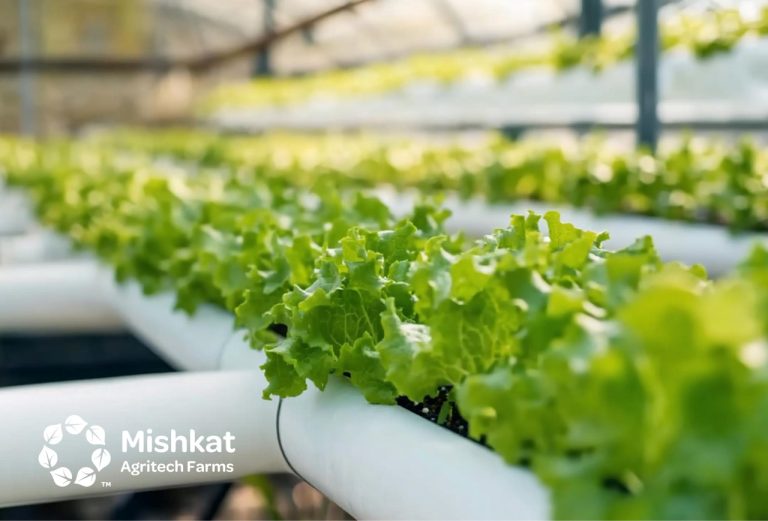
Hydroponic greenhouses are the most common path for a commercial hydroponic farm. The structure is a greenhouse, the environment is controlled to a target range, and the crop runs in a recirculating nutrient solution. This is where hectares of glass hydroponic greenhouses can make sense for tomatoes, cucumbers, peppers, leafy greens, and herbs, as long as your cooling and humidity control are engineered properly.
Best fit:
- Medium to large farms
- Continuous supply contracts
- Crops with stable demand and known agronomy
Model 2: Indoor farms and localized vertical farming (premium and predictable)
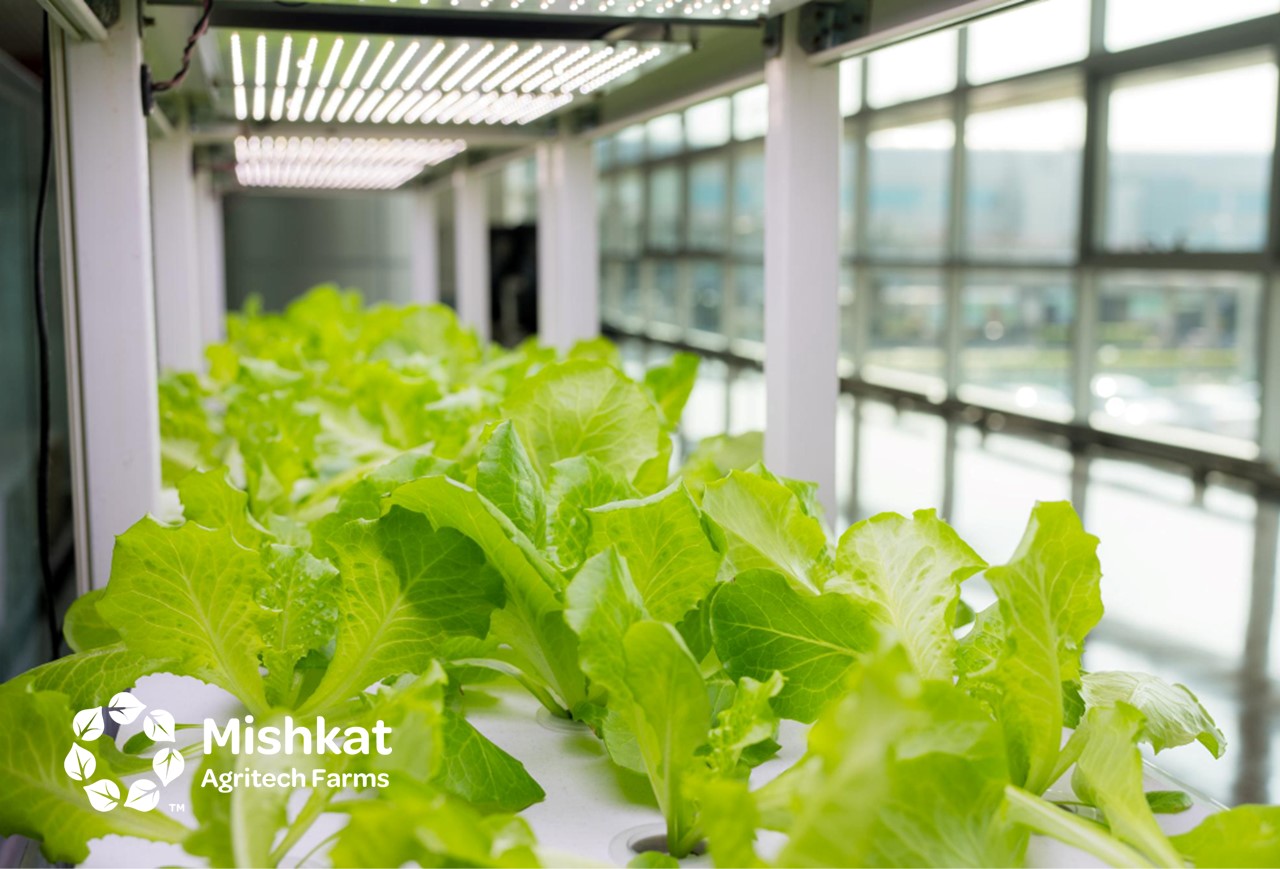
Localized vertical farming technologies are gaining momentum in Saudi Arabia because they can sit near demand, inside cities, and in controlled halls where temperature and humidity are stable. That stability is expensive, but it buys consistency. This model is strongest when you sell premium produce, shorten delivery windows, or attach the farm to hospitality and experience.
Best fit:
- Urban demand
- Premium leafy greens and herbs
- Hospitality developers wanting farm to table
Model 3: Hybrid farms (greenhouse plus vertical layer)
A hybrid design uses a greenhouse for main production and a small vertical farming unit for high margin items, seedling production, or specific SKUs that need higher control. Hydroponic farming in Saudi Arabia often benefits from this approach because it spreads risk and creates a product mix.
Table: Which model fits which business goal?
| Goal | Best model | Why it fits | Main tradeoff |
|---|---|---|---|
| Lowest cost per kilogram at scale | Hydroponic greenhouses | Better CAPEX per square meter, proven supply chains | Climate control is harder in peak summer |
| Premium quality year round | Localized vertical farming | Stable environment, predictable outputs | High energy costs and higher CAPEX |
| Hospitality and education value | Hybrid | Visual storytelling plus product output | More complex operations |
| Fast payback on a small site | Greenhouse or hybrid | Flexible crop mix, simpler staffing | Limited volume, marketing is critical |
Hydroponic systems that work under Saudi conditions
Hydroponic farming in Saudi Arabia is not one technology. It is a set of systems, and the best choice depends on crop, water quality, and operator skill.
The four most common hydroponic systems
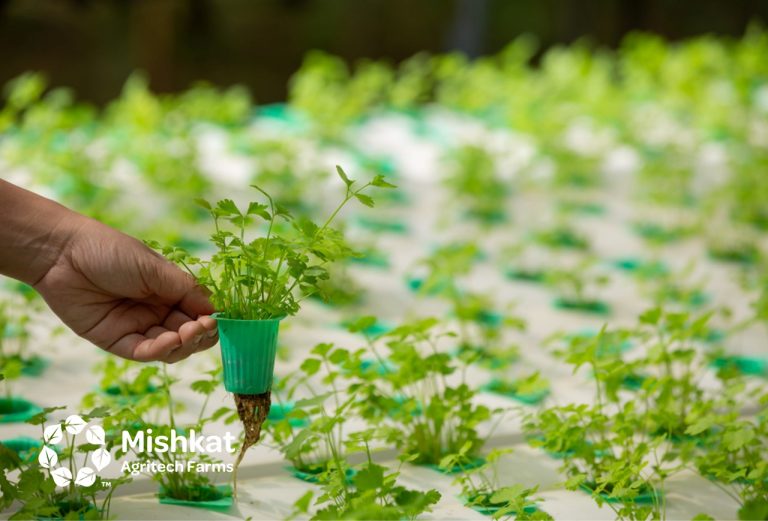
- NFT (nutrient film technique): Great for lettuce and herbs. Sensitive to power outages, because roots dry fast.
- DWC (deep water culture): Very stable for leafy greens, good thermal buffering, but water temperature and oxygen need attention.
- Drip irrigation on inert media: The workhorse for tomatoes and cucumbers. Handles water variability better when designed well.
- Ebb and flow: Useful for nurseries and some herbs. Needs careful sanitation.
Hydroponic farming in Saudi Arabia should also plan for water treatment, filtration, and disinfection as part of the system, not as an afterthought.
Turn your vision into a data-backed plan with Mishkat
Book a quick, free assessment session with the Mishkat Services team: we define your goals and align them with the market and your budget, and deliver a one-page roadmap with expected returns, operating options, and linking to a purchase agreement when needed, with no obligation.
Crop selection: start with demand, then agronomy
In hydroponic farming in Saudi Arabia, crop choice is your first commercial decision. A few practical rules:
- Start with vegetables that buyers already pull weekly: lettuce, herbs, cucumbers, tomatoes.
- Use premium crops only if you have a premium channel: specialty greens, edible flowers, strawberries.
- Match the crop to your environment: coastal humidity is different from central dry heat.
A farm in Saudi Arabia that sells to hospitality can mix “chef friendly” items: basil, mint, arugula, microgreens, and specialty lettuces, with a small volume and high margin approach.
Water quality: the hidden variable
Water in Saudi Arabia can arrive as desalinated, blended, or brackish groundwater. Hydroponic farming in Saudi Arabia must treat water quality as a design constraint:
- Measure EC, alkalinity, sodium, chloride, and boron.
- Decide if you will pre treat with reverse osmosis, blend, or select salt tolerant crops.
- Design drainage and solution management so salts do not creep up week after week.
Poor water management is the fastest path to “mystery problems” that look like nutrient issues but are actually water chemistry.
Climate and energy: the make or break layer
Hydroponic farming in Saudi Arabia is an engineering project wearing a plant costume. In peak summer, the crop is less likely to fail than your climate control plan.
Cooling strategies that actually scale
Common options include:
- Evaporative cooling pads and fans (strong in hot dry regions, weaker in humid coastal zones).
- Shade screens and thermal screens to cut radiation load.
- High efficiency ventilation design to reduce hot spots.
- Mechanical cooling for sensitive crops, typically limited to premium systems.
A practical rule: if your summer design depends on “we will just ventilate more,” you are betting the project on physics being polite. Physics is not polite.
Humidity control: the quiet killer
In many zones, humidity spikes inside a greenhouse at night, especially when you cool aggressively. That raises disease pressure and reduces transpiration, which reduces nutrient flow in the plant. Hydroponic farming in Saudi Arabia needs a humidity plan, not just a temperature plan.
Tools include:
- Proper spacing and airflow.
- Dehumidification where needed for premium crops.
- Night time heating in winter to manage dew point, counterintuitive but effective.
Energy: treat it like a crop input
Electricity is an input that behaves like water, it is invisible until it is expensive. Build an energy budget early:
Turn your vision into a data-backed plan with Mishkat
Book a quick, free assessment session with the Mishkat Services team: we define your goals and align them with the market and your budget, and deliver a one-page roadmap with expected returns, operating options, and linking to a purchase agreement when needed, with no obligation.
- Cooling load in summer
- Lighting load if you do vertical farming
- Pumping, filtration, and water treatment
- Cold chain and packing
If you cannot estimate energy costs within a tight range before building, your business plan is a wish list.
Hydroponic farming in Saudi Arabia becomes far more resilient when you design for energy efficiency, then lock predictable tariffs or generation where possible.
The investor’s unit economics for hydroponic farming in Saudi Arabia
Hydroponic farming in Saudi Arabia is often sold with yield claims. Investors should ignore the hype and focus on unit economics per square meter.
The simple profitability equation
Use this as a baseline:
Annual gross profit = (Yield per m2 × Selling price per kg) − (Variable cost per m2)
Where variable costs typically include:
- Seeds and seedlings
- Nutrients and water treatment
- Packaging
- Direct labor
- Electricity and fuel tied to production
Then subtract fixed costs: rent or land lease, management, maintenance, depreciation, and financing.
What drives revenue in practice
Revenue is not just yield. It is:
- Grade A percentage (how much is sellable at full price)
- Consistency (can you deliver every week)
- Product differentiation (variety, packaging, shelf life)
- Customer mix (retail vs food service vs hospitality)
Hydroponic farming in Saudi Arabia can outperform traditional farming on revenue per kilogram when quality is predictable and shelf life is longer.
What drives costs in practice
The biggest recurring cost surprises are:
- Electricity in summer
- Labor turnover and training
- Disease events that force aggressive sanitation
- Spare parts lead times
- Water treatment consumables
A commercial hydroponic project should maintain a spare parts kit and supplier redundancy, because downtime is a silent tax.
Turn your vision into a data-backed plan with Mishkat
Book a quick, free assessment session with the Mishkat Services team: we define your goals and align them with the market and your budget, and deliver a one-page roadmap with expected returns, operating options, and linking to a purchase agreement when needed, with no obligation.
Checklist: pre investment diligence
Use this checklist before you fund hydroponic farming in Saudi Arabia:
- Define the buyer, product specs, and weekly volumes in writing.
- Confirm water source, water quality tests, and treatment plan.
- Validate the climate model for worst month conditions, not average.
- Identify the operator, farm manager, and agronomist support plan.
- Map the cold chain: harvest, pre cool, pack, transport, delivery.
- Build a maintenance plan for pumps, filters, and sensors.
- Stress test cash flow for a 20 percent yield drop and a 20 percent energy increase.
- Confirm biosecurity: entry protocols, pest monitoring, sanitation.
- Confirm local permits and compliance requirements.
Mishkat Company Services typically starts projects with this diligence layer because it is cheaper to fix a spreadsheet than a greenhouse.
Building the farm: execution details that decide success
Hydroponic farming in Saudi Arabia rewards obsessive execution. The best technology fails when the basics are sloppy.
Site selection: think logistics, not just land
Pick a site by asking:
- How fast can you reach your buyers?
- What is the reliability of power and water?
- What is the local microclimate, wind, dust, humidity?
- Can you hire and retain staff nearby?
A farm in Saudi Arabia that is “cheap land far away” can become “expensive trucking forever.”
Biosecurity and food safety without drama
You do not need fear, you need routines:
- Controlled entry and foot baths
- Clean zones for seedlings and propagation
- Pest monitoring with traps and scouting
- Sanitation schedules for tools and harvest bins
Hydroponic farming in Saudi Arabia can produce premium food only if it behaves like a food business, not like a hobby greenhouse.
Operations: standard operating procedures win
Write simple SOPs for:
- Nutrient mixing and EC and pH checks
- Daily system inspections
- Climate settings by season
- Harvest and packing standards
- Traceability and batch labeling
- Incident response (power outage, pump failure, disease)
Mishkat Company Team often trains operators around these routines because good farms are built on boring, repeatable habits.
Commissioning, KPIs, and the “first 90 days” plan
The build is not finished when construction ends. Hydroponic farming in Saudi Arabia usually wins or loses during commissioning, the period when equipment is tuned, staff are trained, and the biology catches up with the engineering.
Turn your vision into a data-backed plan with Mishkat
Book a quick, free assessment session with the Mishkat Services team: we define your goals and align them with the market and your budget, and deliver a one-page roadmap with expected returns, operating options, and linking to a purchase agreement when needed, with no obligation.
A practical first 90 days plan looks like this:
- Days 1 to 14: run systems with water only, find leaks, verify flow rates, test backup power, calibrate sensors, and train staff on inspections.
- Days 15 to 45: start the first crop cycle with conservative targets, then tighten EC, pH, and irrigation schedules based on plant response.
- Days 46 to 90: lock harvest routines, standardize grading, and validate the cold chain and delivery rhythm with real customers.
Track a small KPI set that tells you the truth quickly:
- Yield per m2 per week
- Grade A percent
- Water use per kilogram (including losses)
- Energy per kilogram, split by cooling, pumps, and lighting if used
- Labor hours per harvested kilogram
- Rejection rate and shelf life feedback from buyers
If you cannot produce a weekly one page report from these KPIs, the farm is operating on feelings, not data. Mishkat Company Services often builds a simple reporting template into the handover so owners can see performance early and take corrective action while costs are still controllable.
Farm to table opportunities for hospitality
Hydroponic farming in Saudi Arabia is not only about selling boxes to retail. For hospitality developers, a farm can be both supply and experience.
Where the value comes from
A farm attached to a hotel or resort can deliver:
- Fresh herbs and greens with zero inventory risk
- A visible sustainability story
- Guest experiences: tours, tastings, cooking classes
- Better menu differentiation
The “experience value” can matter as much as the crop value, especially when guests pay for uniqueness.
How to design it so it does not become a headache
Hospitality sites should keep the farm simple:
- Focus on fast cycle crops: herbs and leafy greens.
- Use a small hydroponic greenhouse that is easy to walk through.
- Build a clear interface between farm operations and kitchen operations.
- Budget for staff who can explain the farm to guests.
Mishkat Company Services can support hospitality design and farm management planning so the farm feels effortless to the operator.
Quick win mini case: a 1,000 m2 hydroponic greenhouse in Madinah
Hydroponic farming in Saudi Arabia can feel abstract until you see a concrete plan. Here is a quick win mini case you can adapt.
Setup
- Location: a farm in Madinah with access to stable power and a water source that can be treated.
- Asset: a 1,000 m2 hydroponic greenhouse with drip irrigation on inert media.
- Crops: cucumbers for baseline volume, plus herbs for margin.
- Channel: weekly supply to nearby food service and hospitality buyers.
Steps (copy this sequence)
- Build a buyer list and lock two weekly buyers for cucumbers and herbs.
- Run full water testing and decide on filtration and blending.
- Design climate control for worst month conditions, including humidity management.
- Install hydroponic systems with redundant pumps and backup power for critical loads.
- Start with one crop cycle for cucumbers to stabilize operations, then add herbs.
- Add a simple cold chain: shaded harvest, quick pre cool, basic packing area.
- Track three KPIs daily: yield, Grade A percent, and energy per kilogram.
- Expand product mix only after the first 8 weeks of stable delivery.
Expected outcome (realistic, not magical)
- More predictable production than open field.
- Higher consistency than traditional farming methods in hot months.
- A cleaner story for hospitality buyers: local, fresh, and controlled.
Mishkat Company Team can help tighten this plan into a bankable project model, including farm design and agronomist training.

Objections and edge cases
Hydroponic farming in Saudi Arabia is not a guaranteed win. Here are the common objections, and what to do about them.
“Energy costs will kill the project”
They can, if you design a climate system that fights the environment instead of working with it. Reduce cooling load with structure design, shading, airflow, and crop selection. Keep localized vertical farming for premium channels that can pay for stability.
“Water is cheap, why bother?”
Water may look cheap on a bill, but the true constraint is reliability and quality. Salts, alkalinity, and interruptions cost yield. Hydroponic systems turn water into measurable productivity, and that can become a strategic advantage.
“Labor is hard to keep trained”
True. The fix is not “hire better people,” it is build simpler SOPs, train for routines, and reduce the number of manual decisions staff must make. Good farms are built like manufacturing lines, with plants.
“Pests and diseases still happen”
Yes, but controlled environments can reduce exposure and allow faster response. The edge case is when you import infected seedlings or ignore hygiene. Biosecurity is not optional.
“The market will not pay a premium”
Then do not build a premium system. Hydroponic farming in Saudi Arabia can compete on consistency and shelf life even when prices are tight, but you must keep costs under control and focus on crops with steady demand.
Next steps with hydroponic farming in Saudi Arabia
Hydroponic farming in Saudi Arabia becomes much easier when you treat it as a system: market, water, climate, operations, and finance all linked. If you are planning a greenhouse, a vertical farming site, or a farm to table experience, Mishkat Company Services can help you scope the right model, pressure test the unit economics, and design for Saudi conditions without overbuilding.
FAQs About Hydroponic Farming in Saudi Arabia
What is the biggest mistake in hydroponic farming in Saudi Arabia?
Under designing climate and humidity control for the worst month. Many projects plan for average weather, then get surprised by peak summer load and disease pressure.
How does hydroponic farming in Saudi Arabia compare with traditional farming?
Traditional farming can be cheaper to start, but it carries higher yield and quality risk in harsh seasons. Hydroponic farming in Saudi Arabia trades that risk for controlled systems costs, aiming for stable output.
Which crops are the safest to start with?
Leafy greens, herbs, cucumbers, and tomatoes are common starting points because demand is steady and agronomy is well understood. Match crop choice to your buyer and your climate design.
Is vertical farming better than hydroponic greenhouses?
Not always. Localized vertical farming can offer tighter control and premium quality, but it usually has higher energy and capital costs. Hydroponic greenhouses are often better for scale.
How much water can a hydroponic farm save?
Savings vary by crop and design, but recirculating systems typically use far less water than open field irrigation because water is reused rather than lost to soil and evaporation.
What does a serious investor ask for before funding?
A buyer plan with weekly volumes, a climate model for worst month conditions, water test results, an operator plan, and a realistic cash flow model with stress tests.
Can a hospitality project run a farm without becoming a distraction?
Yes, if the farm is sized for the kitchen’s needs, uses simple crops, and has dedicated operations support. The farm must be designed for both production and guest flow.
How long does it take to reach stable operations?
Many farms need 8 to 16 weeks after commissioning to stabilize systems, staff routines, and consistent quality, assuming the design is sound.
What role does Mishkat Company play?
Mishkat Company provides farm design, hydroponics and aquaponics expertise, farm management planning, hospitality integration concepts, and agronomist training to help projects reach stable production faster.
Conclusion About Hydroponic Farming in Saudi Arabia
- Hydroponic farming in Saudi Arabia is driven by water constraints, climate stress, and demand for consistent fresh produce.
- The right model depends on region, revenue channel, resources, and risk.
- Hydroponic greenhouses are usually the best scale play, while localized vertical farming fits premium and urban use cases.
- Water quality and humidity control decide more outcomes than “which system” marketing.
- Investors should insist on unit economics per square meter, not headline yield claims.
- Execution wins through SOPs, biosecurity, and a disciplined energy plan.
Hydroponic farming in Saudi Arabia can be profitable and scalable, but only when the project is designed for the desert reality, then operated with manufacturing level discipline.
Proof and credibility About Hydroponic Farming in Saudi Arabia
This guide reflects common failure points and success patterns seen across controlled environment agriculture in the region: climate modeling that respects worst month conditions, water quality management, and operations built around repeatable routines. Mishkat Company Team focuses on system design, practical farm management, and agronomist training, because technology alone does not create reliable production.
Sources About Hydroponic Farming in Saudi Arabia
- General Authority for Statistics (Saudi Arabia), 2025, https://www.stats.gov.sa/en/w/news/8
- General Authority for Statistics (Saudi Arabia), 2025, https://www.stats.gov.sa/en/w/news/127
- United States Department of Agriculture Foreign Agricultural Service, 2023, https://apps.fas.usda.gov/newgainapi/api/Report/DownloadReportByFileName?fileName=Retail+Foods_Riyadh_Saudi+Arabia_SA2023-0006.pdf
Turn your vision into a data-backed plan with Mishkat
Book a quick, free assessment session with the Mishkat Services team: we define your goals and align them with the market and your budget, and deliver a one-page roadmap with expected returns, operating options, and linking to a purchase agreement when needed, with no obligation.